Project Overview
Active noise cancellation and call noise reduction are distinct noise reduction technologies. Active noise cancellation aims to minimize environmental noise to the greatest extent, allowing the user of the headphones to enjoy a quiet environment. On the other hand, call noise reduction is applied in a different context; it enables users of noise-cancelling headphones to make phone calls on a noisy street, or while riding a motorcycle, or in a car with music playing or windows down, and ensures that the person on the other end of the call can clearly hear your speech without much background noise interference. In simple terms, active noise cancellation is about the comfort of the headphone user, while call noise reduction is about the clarity of communication for the person on the other end of the call.
There are three main technologies for call noise reduction:
Beamforming - Directional enhancement technology that focuses the microphone's sensitivity in a specific direction to capture the speaker's voice more clearly.
Adaptive Filtering - A technique that adjusts the filtering process in real-time to better distinguish and isolate the speaker's voice from background noise.
Bone Conduction Technology - A method that uses vibrations conducted through the bones of the user's head to pick up their voice, which can help in noisy environments by providing an additional source of voice signal that is less affected by ambient noise.
These three technologies are not actually new; our smartphones, which typically have two microphones (one next to the charging port and the other near the camera), have been quietly assisting us with call noise reduction for many years (hence, sometimes when we are worried about not being clearly heard on a call with headphones, we instinctively switch back to the phone itself—this is mainly the reason). The essence of the bone conduction technology is to collect vibration signals from the face or vocal cords for call transmission. Since environmental noise is transmitted through the air, using an accelerometer to directly capture the vibrations from your face or vocal cords can isolate the environmental noise. This technology is widely used in the military, such as making calls inside tanks or on helicopters.
Now, the form factor of TWS (True Wireless Stereo) earbuds has accelerated the application of these three technologies. The golf club-like shape of TWS earbuds allows for a greater distance between the dual microphones, enhancing the effectiveness of the beamforming algorithm; the semi-in-ear form factor of TWS allows for more efficient transmission of vibrations from the ear cartilage to the accelerometer, resulting in higher signal-to-noise ratio for the bone conduction; at the same time, the optimization of computing power and power consumption of Bluetooth chips enables these algorithms to run better on TWS chips.
Today, we are discussing beamforming directional enhancement technology.
We also hope that this article can help everyone avoid redundant investment in equipment. Call noise reduction will definitely become a standard feature for mid-to-high-end TWS earbuds, and earphone manufacturers need to be sensitive to this trend and make cautious choices in testing equipment investment. It is necessary to choose a system that can be upgraded for call noise reduction testing; otherwise, it may be necessary to spend a significant amount of money to upgrade the existing Bluetooth audio testing system or purchase a new one that supports call noise reduction testing. In fact, with good planning, regular Bluetooth acoustics and call noise reduction can be completed at one station, and our system supports this.
An Introduction
What is Beamforming? — Beamforming with dual microphones uses the phase difference of the voice signals captured by two microphones to achieve directional pickup. It enhances the voice of the person wearing the headphones and suppresses environmental interference and noise, enabling clear voice calls in noisy environments. In research and development testing: a turntable is used to test the HFP energy of the headphones at every angle, with the signal being a fast sweep frequency (continuous logarithmic sweep, not octave) (the adaptive filter has not yet converged, and the received signal is only the signal processed by beamforming).
How to measure the noise reduction effect of the Beamforming algorithm during the development phase?
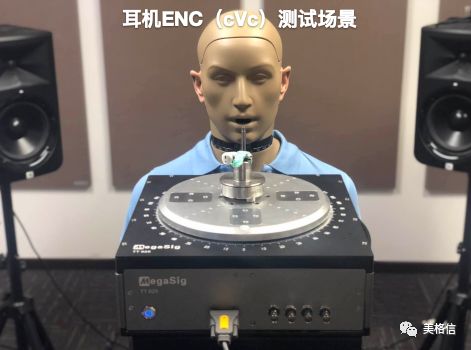
Below is an illustration of how we conduct Beamforming noise reduction effect testing for TWS headphones in an office setting.
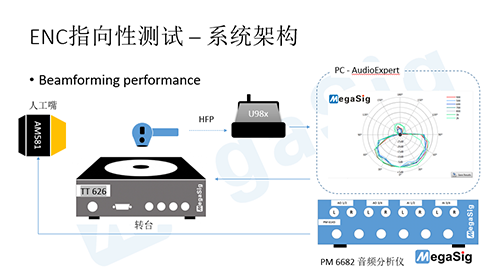
The system architecture is as shown in the diagram below. We use a rotary table TT625 to measure the HFP transmission energy of the headphones at every angle. If we use a sweeping frequency signal, it can be assumed that before the adaptive filter has fully converged, the received signals are considered to be processed only by the beamforming directional enhancement.
The following image is a comparison of the Beamforming noise reduction effects between AirPods and a certain brand's TWS earbuds.
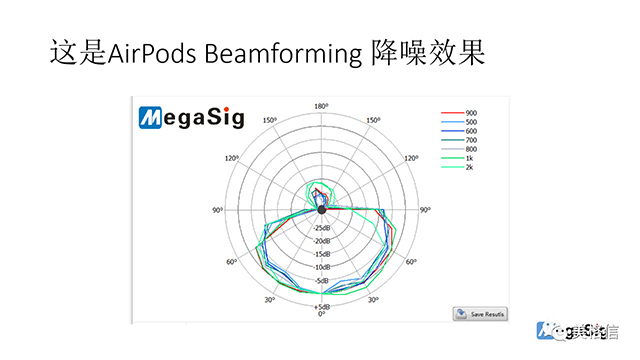
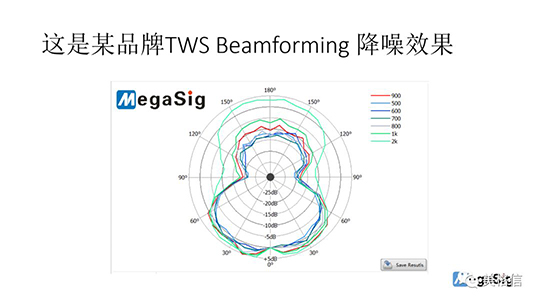
The two aforementioned figures demonstrate that the AirPods exhibit superior performance, characterized by a significant reduction at the 90-degree mark. This suggests that while utilizing AirPods for a phone call, if an individual of similar height to you speaks directly towards your ear, their voice will be considerably diminished, minimizing the sound transmitted to the recipient of the call. Additionally, when walking outside, the noise from car horns will be largely suppressed, thereby achieving a highly effective noise reduction for calls.
 CN
CN
