- Products
SensorsMicrophone kitEar simulatorMouth SimulatorShakerPreamplifiersSpeed SensorsSensor AccessoriesMeasurement microphoneArtificial MastoidPlane SourceVibration SensorsSimulator HeadCalibratorDynamic ForceInstrumentsPM SerialsLR SerialU SerialsN SerialsWind Noise SimulatorSound Level MetersRotary tablesSoftwaresBuildGoAudioExpertVQBenchStingerSIO LabMagnumBT LabSignalBenchAccessoriesAuxiliary InstrumentsAnechoic ChambersCablesInstallation kits
- Solutions
- Technology
- About Us
-
 CN
CN
Bone Conduction Finished Headphone Testing Solution
Project Overview
Bone conduction is a method of transmitting sound waves to the inner ear through skull vibrations, allowing individuals to perceive sound. Compared to the typical air conduction method, where external sounds are heard via air transmission, bone conduction enables audio transmission that achieves a noise-filtering effect similar to air conduction.
Bone conduction headphones are devices developed based on this principle and can be categorized into two types: those utilizing bone conduction speaker technology and those employing bone conduction microphone technology.
Today, we will focus on the former—bone conduction speaker technology headphones. These devices generate vibrations via a single actuator, which are then transmitted through the skull to the auditory nerve, allowing sound to be perceived without passing through the ears. However, when manufacturing finished bone conduction headphones, consistency often becomes a challenge. Additionally, due to the unique nature of bone conduction, the requirements for testing fixtures are particularly high. To address these issues, Megasig offers a comprehensive system—from software testing algorithms to hardware testing equipment—that efficiently and accurately visualizes test data for finished bone conduction headphones, providing actionable insights.
An Introduction
The test parameters for bone conduction headphone speakers include: Frequency Response, THD, Sensitivity, Impedance, Polarity, and Rub&Buzz.
The test parameters for microphones include: Frequency Response, THD, and Sensitivity.
Test Chain for Finished Bone Conduction Headphones
Here, the test chain for finished bone conduction headphones is used as an example for illustration:
1、Test Chain for Bone Conduction Headphone Speakers:
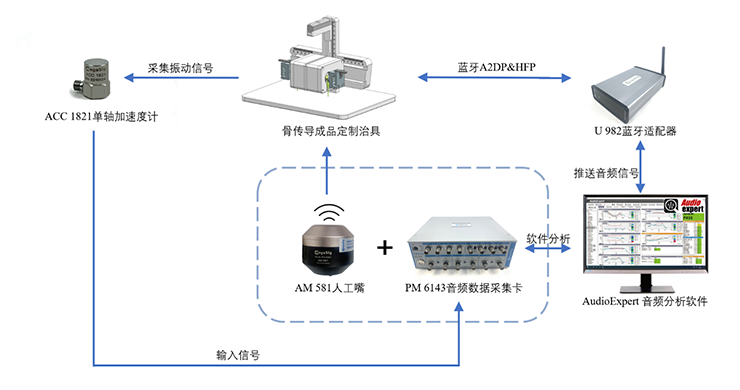
The finished bone conduction headphone is connected to and interacts with a U 982 Bluetooth adapter. AudioExpert pushes audio signals via the Bluetooth A2DP protocol to vibrate the headphone's speaker. An ACC 1821 single-axis accelerometer, paired with a customized fixture, captures the vibration signals and transmits them to a PM 6143 audio data acquisition card. The captured signals are then sent back to the AudioExpert audio analysis software for signal analysis.
2、Test Chain for Headphone Microphones:
The finished headphone is connected to and interacts with a U 982 Bluetooth adapter. AudioExpert pushes audio signals to a PM 6143 audio data acquisition card, which then transmits them to an AM 581 artificial mouth to produce acoustic signals. The microphone of the finished headphone captures the signals and transmits them back via the Bluetooth HFP protocol through the U 982 Bluetooth adapter to the AudioExpert audio analysis software for signal analysis.
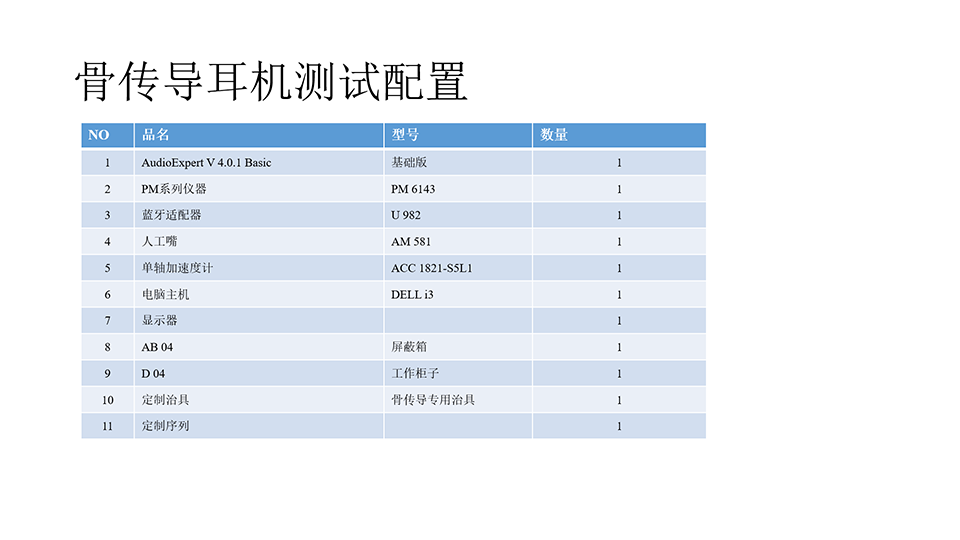
Configuration List
Summarize
About Us
Products
Solutions
Technology
Join Us
Contact Us

Copyright © 2014 MegaSig. All rights reserved. 版权所有 粤ICP备15009411号
