- Products
SensorsMicrophone kitEar simulatorMouth SimulatorShakerPreamplifiersSpeed SensorsSensor AccessoriesMeasurement microphoneArtificial MastoidPlane SourceVibration SensorsSimulator HeadCalibratorDynamic ForceInstrumentsPM SerialsLR SerialU SerialsN SerialsWind Noise SimulatorSound Level MetersRotary tablesSoftwaresBuildGoAudioExpertVQBenchStingerSIO LabMagnumBT LabSignalBenchAccessoriesAuxiliary InstrumentsAnechoic ChambersCablesInstallation kits
- Solutions
- Technology
- About Us
-
 CN
CN
G616 acoustic safety testing system
Project Overview
This plan is based on G616:2013 "Acoustic Safety Guidelines for Telephone Equipment" and AS/NZS 1269.1:2005 "Occupational Noise Management Part 1: Measurement and Evaluation of Noise Emission and Exposure", to conduct acoustic shock protection equipment limit value (ASPDL) and 8-hour equivalent continuous A-weighted sound pressure level (LAeq, 8h) testing on telephones or headphones to verify whether the product meets the acoustic safety requirements of Australian telecommunications equipment, prevents acoustic shock injuries and long-term noise induced hearing loss risks.
An Introduction
The MegaSig acoustic safety testing system is strictly built in accordance with the industry standards G616:2013 "Acoustic Safety Guidelines for Telephone Equipment" and AS/NZS 1269.1:2005 "Occupational Noise Management Part 1: Measurement and Evaluation of Noise Emission and Exposure", establishing a professional testing system.
The following text uses TWS earphones with Bluetooth as an example to explain the testing items:
1、G616:2013- ASPDL Test for Acoustic Shock Protection Equipment Limits:
Establish a stable HFP voice connection with the tested TWS earphones using the MegaSig U 987Q Bluetooth adapter, and tightly couple the earphones to the CM 311+A 804 artificial ear that meets ITU-T P.57 Type 2 requirements (measured directly at the tympanic membrane reference point DRP). BuildGo software controls the U 987Q to output 500ms pulse pure tone to the headphones, with a frequency strictly following the specified values in Table 1 of G616:2013, and an input level range of -12dBFS~+7dBFS (step size 2dB); The CM 311+A 804 artificial ear collects the sound signal and transmits it to the PM 6682 data acquisition card. The data acquisition card then transmits the signal to the BuildGo software for analysis.
Test all supported HFP speech encoding and working modes, measure the left and right ears separately, and verify that the maximum output sound pressure level at each frequency point does not exceed the ASPDL limit at the DRP position specified in G616:2013 Table 1.
2、AS/NZS 1269.1:2005-8-hour equivalent continuous A-weighted sound pressure level (LAeq, 8h) test:
Use the MegaSig U 987Q Bluetooth adapter to establish a stable HFP voice connection with the tested TWS earphones, and tightly couple the earphones to the AH 265+AT 235 simulated human head that meets the requirements of ITU-T P.58 human anatomy or the CM 311+A 804 artificial ear that meets the requirements of ITU-T P.57 Type 2 (measured directly at the tympanic membrane reference point DRP). Set the local volume of the headphones and the absolute volume of HFP on the Bluetooth tester to the maximum position. The BuildGo software controls the U 987Q to output the ITU-T P.501 standard artificial voice signal to the headphones. The AH 265+AT 235 simulated human head or CM 311+A 804 artificial ear collects the sound signal and transmits it to the PM 6682 data acquisition card. The data acquisition card then transmits the signal to the BuildGo software for analysis.
Test all supported HFP voice encoding and working modes, measure left and right ears separately; The measurement results are converted into equivalent diffuse field values (LAeq minus 5dB, Lpeak minus 3dB) according to standard requirements. The energy weighted average method is used to calculate the normalized equivalent continuous sound pressure level LAeq for an 8-hour workday, which is 8h. Extended shift adjustments and background noise corrections are made according to regulations. Verify that the adjusted LAeq does not exceed 85dB (A) after 8 hours (90dB (A) in South Australia), and the peak sound pressure level Lpeak does not exceed 140dB (C).
Configuration List
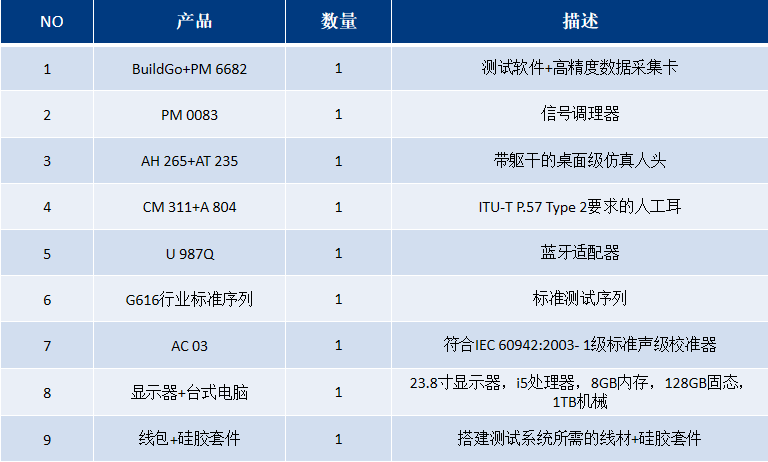
Summarize
The MegaSig acoustic safety testing system is currently a professional and cost-effective solution on the market, meeting the testing requirements of G616 and AS/NZS 1269.1 standards. The system is equipped with automated testing sequences, which can significantly improve testing efficiency and effectively reduce human testing errors.
About Us
Products
Solutions
Technology
Join Us
Contact Us

Copyright © 2014 MegaSig. All rights reserved. 版权所有 粤ICP备15009411号
